ALL FORUM – On December 3, 2024, I was on my way home after finishing classes at school. In a KakaoTalk group chat with my friends, one of them suddenly sent a message: the president had declared martial law. At first, I thought, “That must be fake news.” But in real time, former President Yoon was indeed declaring martial law. I hurried home and told my dad. He also said, “That must be fake news,” but as soon as he turned on the TV, there it was—President Yoon announcing martial law. “It’s real!!!!” Both my dad and I were shocked, and that night, we couldn’t sleep.
Martial law is a word that, for someone born in the ’90s like me, had always felt distant—something I only read about in history books or saw in movies. The film A Taxi Driver (2017, directed by Jang Hoon) portrays the period after President Park Chung-hee was assassinated on October 26, 1979. Under the Choi Kyu-hah administration, the military junta, led by Chun Doo-hwan and Roh Tae-woo, gradually consolidated power. On May 17, 1980, martial law was expanded nationwide: the National Assembly was dissolved, universities were closed, and political activities were banned. Citizens in Gwangju took to the streets to demand democracy, facing illegal oppression, and many lost their lives. The protagonist, Kim Man-seop, an ordinary taxi driver in Seoul, is offered a large sum of money if he drives to Gwangju before curfew to pay overdue rent. Accompanying him is Peter, a German journalist. Upon arrival, Kim witnesses firsthand the military’s violence and the citizens’ resistance.
The Attorney (2013, directed by Yang Woo-seok) is set against the backdrop of the 1981 Burim case. Twenty-two members of a social science reading club were arrested without warrants, tortured, and prosecuted. Students and citizens had gathered to discuss democracy and engage in reading groups, but the junta labeled them as dangerous threats and suppressed them. Martial law and political security cases were not mere political measures—they were instruments to stifle citizens’ freedoms and democratic aspirations. The attorney in the film, based on former President Roh Moo-hyun, defends students’ rights in court, exposing the military junta’s abuse of power and unjust martial law measures, fighting to uphold democracy and protect citizens.
Seoul Spring (2023, directed by Kim Sung-soo) focuses on the period between President Park’s assassination on October 26, 1979, and the nationwide expansion of martial law on May 17, 1980, under Chun Doo-hwan. The term “Seoul Spring” refers to the time from October 26, 1979, to May 18, 1980, when numerous democratic movements arose across South Korea. During the Choi Kyu-hah government, citizens hoped for the end of the Yushin regime and the realization of democracy. Students protested against pro-government professors at universities and resisted compulsory military training. On April 24, 361 professors from 14 universities issued a statement calling for democratization in education, criticizing hereditary systems and reappointment policies in private schools. However, the junta deployed martial law troops to suppress these demands, and the resulting social tension ultimately led to the Gwangju Democratization Movement. The “Seoul Spring” ended violently when martial law troops brutally suppressed the uprising, leaving 229 dead or missing and over 3,000 injured.
The martial law I had only seen in movies—the one that should never happen again—happened once more in South Korea on December 3, 2024.
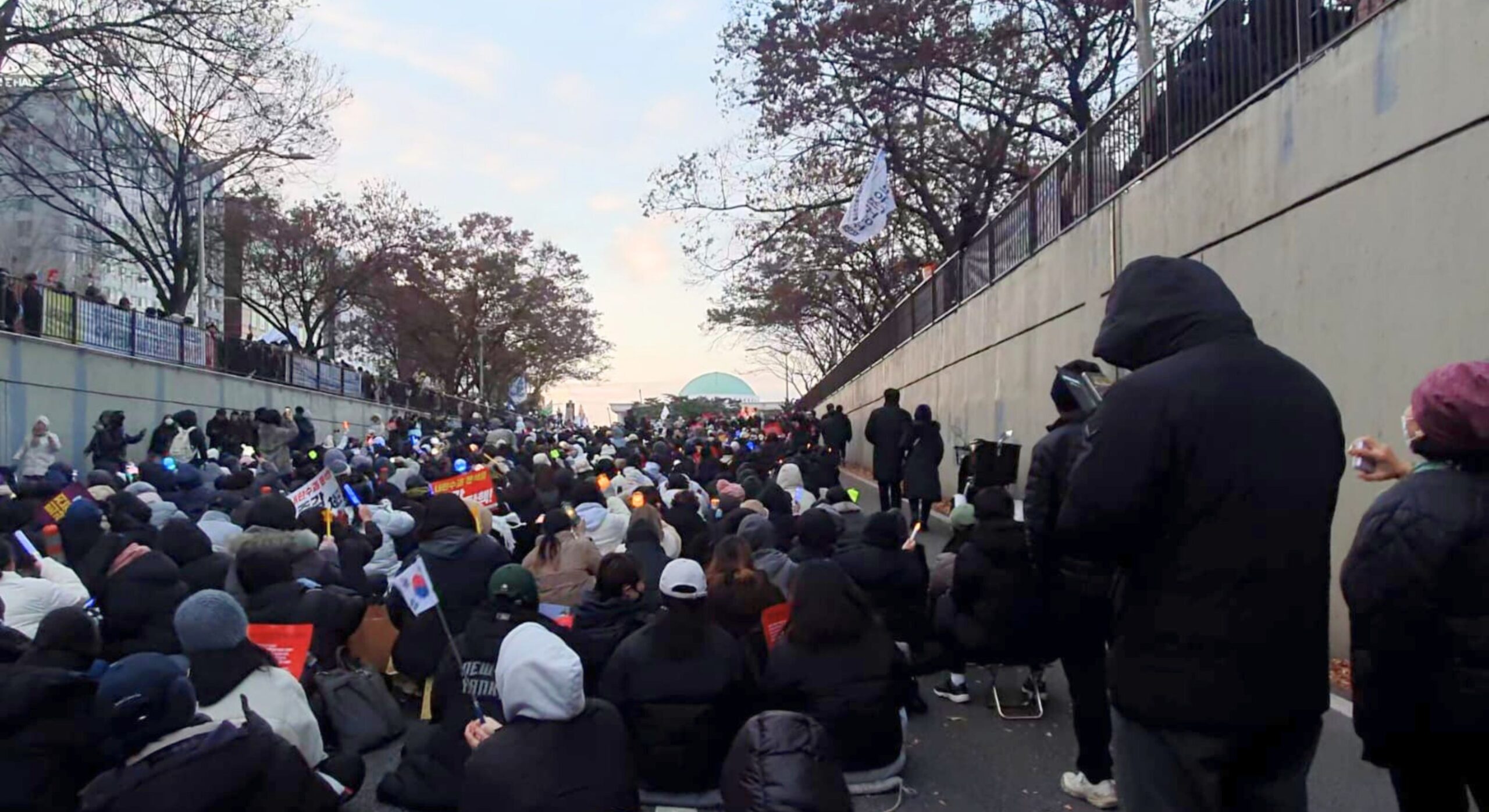
During this time, members of the National Assembly gathered inside to block the martial law, while citizens stood guard outside. Voices demanding that armed conflict never happen again converged. Martial law ended within a single day, but its reality struck us as if it had stepped straight out of a film. Citizens flooded the streets, refusing to let a president who endangered the nation remain in office. From the moment martial law was declared, they gathered daily in front of the National Assembly, singing and calling for President Yoon’s resignation. The ruling party cautiously began defending him, but citizens would not back down. After finishing work each day, they went out to the streets with friends and family. Until President Yoon’s impeachment, citizens kept coming out.
One day, after a protest with a friend’s family, we went to eat fried chicken and drink beer. It was the dead of winter, and our bodies were frozen solid. As soon as we entered the restaurant, we felt the warmth. In that old-style chicken shop, people who had been protesting nearby gathered in small groups. Watching the news, we began talking to the uncle sitting next to us. My friend’s parents, as well as the men at the next table, had participated in democratic movements in the past. They spoke of the importance of learning from history and ensuring past mistakes were never repeated. For the first time, my friend and I felt the weight carried by adults in their 40s and 50s. In that moment, we confronted a history that must never repeat itself and witnessed the power of citizens to prevent it. Human strength may be limited, but we could see what ordinary people, coming together, could achieve. Even when the future seemed bleak, people gathered and moved toward what was right. When asked about Korean history, I answered, “We already have a generation that resisted.” And so, the Seoul Spring returned once again.*