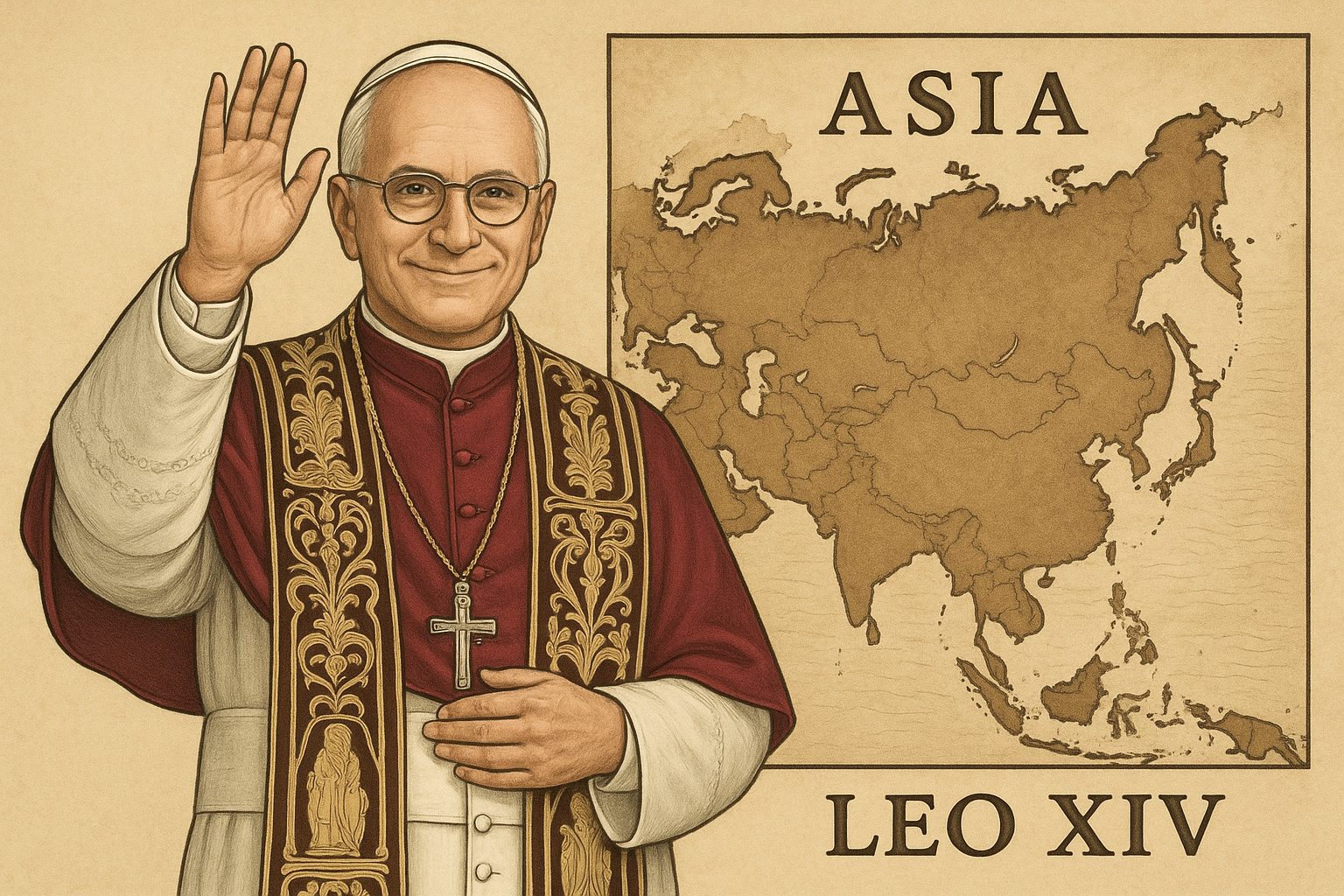
Following the passing of Pope Francis, a new pope has ascended: Leo XIV, a member of the Augustinian Order. Born in 1955, he is now 69 years old. Unless there are unforeseen health issues, he is expected to lead the Church for the next 15–20 years. He previously served two terms as the Prior General of the Augustinians, a male religious order with a long and venerable history.
Leo XIV has deep ties with Pope Francis. In 2015, Pope Francis appointed him as Bishop of Chiclayo in Peru, and in 2023 he was appointed Prefect of the Dicastery for Bishops and elevated to Cardinal. Although born in the United States and spending his youth there, Leo XIV has spent most of his life as a missionary in Peru and Rome.
Just as Pope Francis chose his papal name inspired by St. Francis of Assisi, Pope Leo XIV is said to have been influenced by Pope Leo I (the Great) and, particularly, Pope Leo XIII. Pope Leo XIII issued Rerum Novarum at the end of the 19th century, the first encyclical addressing labor and capital issues, thus becoming the pioneer of Catholic Social Teaching (CST).
By choosing the name “Leo XIV,” the new pope signals his desire to apply CST to today’s challenges and reveals where his pastoral priorities lie. In his first address to the College of Cardinals on May 10, he pledged to continue Pope Francis’s reforms and to remain committed to the spirit of the Second Vatican Council. He stated: “Today, the Church is facing yet another industrial revolution in the form of developments in Artificial Intelligence (AI). In response, the Church offers its social teachings as a gift to humanity, to uphold human dignity, justice, and labor.”
For him, CST is not merely doctrinal inheritance but the Church’s mode of relating to the world, calling for faithful responses to the new questions posed by changing times. His comparison of AI to the Industrial Revolution underscores his awareness of its far-reaching impacts.
Across Asia and the Global South, the poor continue to suffer from deepening poverty and economic inequality. Poverty today is not merely a matter of absolute deprivation but of structural and widening inequality, fueling what Pope Francis called “the globalization of indifference.” This exposes the injustices of neoliberal capitalism as an entrenched social evil.
Extreme polarization caused by globalization and neoliberalism has become the defining face of poverty today. Migrants and refugees, unable to remain safely in their own lands, symbolize and embody this structural violence. The international community must respond, and the new pope’s concern and support are urgently needed. His words and actions will greatly influence Catholics worldwide, especially young people. Asian youth, including those in ALL Forum, likely hold high hopes for Pope Leo XIV, as they did for Pope Francis.
In this light, another urgent pastoral priority for Pope Leo XIV is the concrete realization of a “Synodal Church,” a legacy of Pope Francis. Synodality points beyond internal church reform to communion with the world and nature. For the Church to confront war and peace, poverty and inequality, and the climate crisis, the vision of a synodal Church must become reality.
Synodality was the central theme of the 16th Ordinary General Assembly of the Synod of Bishops held from 2021 to 2024. From the diocesan and parish levels upward, the Synod gathered the voices of the People of God through listening, dialogue, and discernment. Pope Francis officially approved its final document, urging local churches to implement synodality over the next three years. Yet many churches still struggle to grasp and embody its true spirit. Bishops and priests bear heavy responsibility. If the Church fails to renew and reform itself, it loses not only internal credibility but also its witness to the world. As with a cancer left untreated in one’s body, it cannot truly care for others while ignoring its own decay. For this reason, we as Catholics, especially Asian Catholics, believe Pope Leo XIV must give particular attention to the full realization of synodality in his papacy.