Since the beginning, people have continuously tried to understand God, religion, life and the world. Discoveries like fire and the wheel have changed history and paved a new path toward a fresh search, resulting in human beings becoming an agent of transformation and making the world a wonderful habitat of joy and relationships. Over time, people realized that everything in the entire universe is interconnected, where every single rhythm of the world when combined together creates joy and hope for humanity. And that, everything that happened in the universe is the result of all things working together. Therefore, understanding this principle makes us more humane and complete.
From this, we learn that the relationship between the Church and the state should not be derailed, as doing so could lead to chaos and chasm. History shows that the Church has always been influenced by the culture, politics, and economy of the state, and connected to the challenges of daily life. Wars, plagues, famines, the rise of local cultures, and the ideas of modernity and the Enlightenment—with their focus on human-centered thinking (anthropocentric world view)—all tested the Church and its role in the world. These challenges led to the Second Vatican Council, where the Church sought to respond to modern realities, renew what could be renewed, and to reach out to other Christians in a spirit of reconciliation—an endeavor Pope John XXIII called a “New Pentecost.”
Therefore, each situation in history brings new challenges which calls for new change, and give rise to a new kind of leaders who are suited for what is needed at that moment. The vocations of Moses, the O.T. prophets, Mary, Jesus, his disciples, and Pope Francis show that true leaders, guided by conviction and commitment rather than convenience, bring deep transformation both in the lives of the believers and the Church. The way leaders use power- whether to inspire or to control- affects how people think and act. When leaders use power only to command or force, it becomes “hard power”, leading to fear and payments.
Hard power reminds us of the idea of “conquer and consume.” We see this kind of power throughout history and even today—in wars, genocide, political repression, the stirring speeches of politicians, and in the cyber world. Here, human minds and actions are monitored and influenced by what we can call the “internet-wet-bet syndrome,” where people are drawn in, shaped, and trained to fight invisible wars created by supercomputer wizards. Pretention is the crucial principle of hard power, which can create fake narratives, confer false promises and defame the alterity. In short, leaders who believe in hard power take this world as their exclusive privilege.
Against such a backdrop of hard power, we shall reflect upon the leadership of Pope Francis, whose main focus is to give shape to the hopes and dreams of the vulnerable Other of humanity. From “conquer and consume”, Pope Francis replaced it with a mantra of soft power which is “compassion and communion”. Pope Francis has indeed mastered the art of soft power that cultivates deep respect for the existence of the Other in his ministry, and he see himself as a pilgrim of peace and an apostle of hope. In this article, let us explore a few expressions of Pope Francis’ pastoral pilgrimages, their impact on the world, and how they empower the margins of the Church and the state.
To a Pilgrim, the Voice of the Weak is not a Cacophony but a Call
Every pilgrimage is a unique journey with a profound purpose, where each pilgrim has an obligation to take care of his/her own companions, especially those who are weak and mostly forgotten. Pope Francis’ works shows us what it means to be a true pilgrim—it is a call. It makes a person rooted in his/her commitment and responsibility toward oneself and humanity. It is a moment of experiencing deeply the true transformation that takes place within the inner core of oneself. Just like how Moses felt a call within himself to fulfill the will of God, he led the Israelites out of misery and pain and led them to a path of pilgrimage. In this moment, we saw the deeper concern of God after hearing the voice of the weak. Listening to the voice of the poor is to follow the divine path. The voice of a suffering is not a cacophony, but rather it is a divine demand to be absorbed and provoked by the suffering Other. In fact, this must remain at the heart of the Church’s mission today. To truly be the Pilgrim Church, we need sensitive hearts, courage, and inclusiveness. Our journey continues, and there is still a long way to go. And this is a sacred journey, a pilgrimage. That is why the II Vatican council calls the Church a Pilgrim church.
This pilgrimage requires ears to hear the weak, eyes to see strength in the fragile, hands to comfort the needy, and shoulders to lift victims of war and injustice. Pope Francis draws our attention of a danger of becoming indifferent, being incapable of feeling compassion for the poor and the suffering, and think that helping them is someone else’s responsibility and not on our own. The Church’s pilgrimage is powered by genuine love for God, a force that reboots the potential of the repressed. This journey, though difficult, demands courage and vision. As St. Oscar Romero reminds us, the pilgrim Church also faces misunderstanding and persecution but walks serenely with the power of love. This love helps us discover the mystery God has placed within us since birth — a mystery revealed through ongoing search, care, concern, and the ethical transformation of both individuals and structures.
Divine Mystery is the inspiration to Imagine Soft Power
Every mystery awaits the right moment, place, and person to uncover it in the larger interests of humankind. Therefore, speaking or writing about the divine mystery is not just a utopian idea, but instead, it is something deeply connected with the real change or revolution that is going to happen. It is reality imbued with the hidden presence of God.” The Holy scripture empathically tells this truth. All their personalities and narratives in the bible speak about God’s unwavering commitment to this world and humanity.
Another essential thought that emerges in the theological thinking of Pope Francis is that when a person is struck with the call of the divine, he or she will enter into the realm of an encounter with the person of God, with Jesus, which eventually will lead him or her to feel different from the other, meaning to enter into a profound transformation within the self of a person who lives within the aura of the mystery of God.
Therefore, the mystery of God that operates within us repeatedly produces a power to create something new. The newness enhances our thoughts, behaviors, and approach towards the world outside the measured territories, our relationships, and above all our convictions and options. We all know that power is a neutral agent; “it is omnipresent…, it can be found in all social interactions…It seems… power is always already there, that no one is ever outside it.” “We inhabit power the way fish swim in the water. It is simply the environment in which we live and act. Power is mentality.”
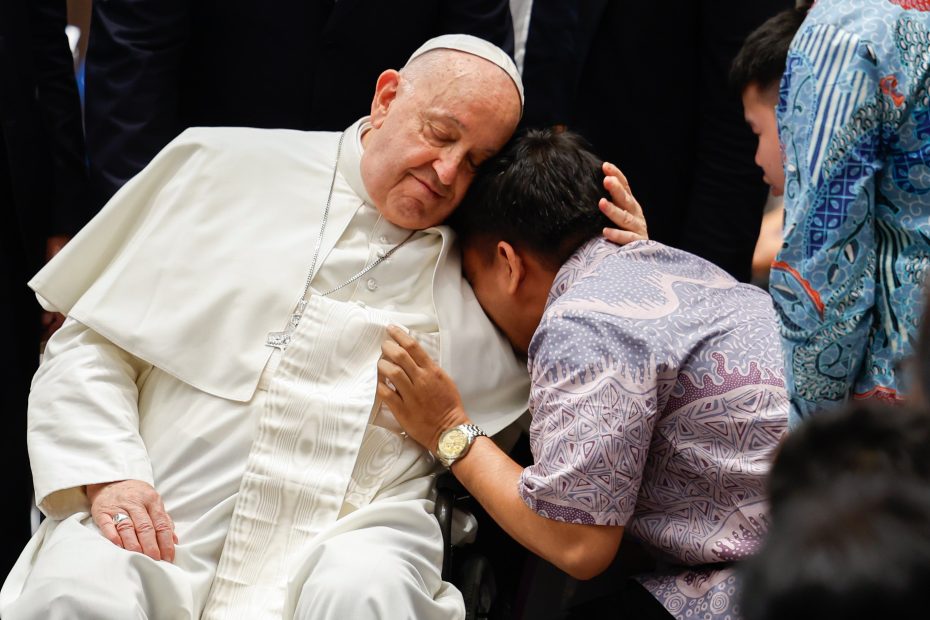
Now let us reflect on some events from Pope Francis’ pastoral work, on how his power which is rooted in his deep encounter with God through the presence of the unknown Other — became a force of attraction and transformation, energized by the mystery of God. In 2013, Pope Francis humbly touched the feet of South Sudan’s rival leaders, Salva Kiir and Riek Machar, a humble gesture, hoping to end a war that had killed 400,000 innocent civilians. As Gregory Baum said, “The riddle of life… can be resolved only through commitment and action. Human life is unified through love.” Later that year, on November 18, Pope Francis embraced Vinicio Riva, a disfigured man, who recalled, “It lasted not more than a minute, but it seemed an eternity… I felt only love.” Pope Francis also appointed six women to the Vatican’s financial administrative body — these, all showing the soft power that he gained through experiencing God’s mystery. “Soft power rests on the ability to shape the preferences of others.”
Hence, reaching out to the unchartered terrains of human society is indeed a trait of Pope Francis’ leadership. For him, the Church, as the living body of Christ, must meet the need of the hour and heal the wounds of suffering humanity, like a field of hospital—centrifugal, humble, and open without walls that makes the concerns of the people and the wounds of humanity its own and tries to respond to them. This image of the church by Pope Francis, gives us a clear picture of his inner disposition and his radical commitment for the wellbeing of the whole universe that pulsates with power divine.
Conclusion: Pope Francis a “Parrhesiastes” with a Prophetic Consciousness
From what we have seen so far about Pope Francis and his approach toward the use of power, we could learn that “the mystery of human existence lies not in just staying alive, but loving everything with a sense of moral integrity and justice. In fact, this ethical outlook makes everything beautiful and provides an exchange of energy, which creates an inert world to come alive. Allowing every single reality to flourish on its own endows a higher purpose in one’s life. Pope Francis has this spirit in his mind. Almost all his encyclicals proclaim this good news to humanity and the world at large.
Pope Francis’ thoughts attracted a wide range of people beyond the narrow boundaries of religions. They capture important elements of human life, namely, a sense of happiness, the joy of being genuine person, living close to the spirit of Christ, being with the spirit of the gospel, caring for the common home, fraternity, and social relationship, etc. These bring soft power to the fore.
Such a soft-powered approach that Pope Francis adopted in the public sphere was characterized by the American Magazine Rolling Stone as a miracle to the ordinary faithful. It says,
A man whose obvious humility, empathy and above all devotion to the economically disenfranchised has come to feel perfectly suited to our times… His voice is disarmingly gentle… Francis’ basic mastery of skills, smiling in public seemed a small miracle to the average Catholic.
Hence through his pilgrimage, Pope Francis has been guiding the Catholic Church for the past ten years as a bridge of dialogue with the world and the varied expressions of humanity. With his empathic appropriation of soft power, he brings new meaning to the exercise of power. That is, power is service but not a privilege or an instrument of control and command. He moves with a strong spirit of divine mystery and looks at the world with an aesthetic sense in order to add more beauty and goodness.